RNO2021 – Ana García Cabrera galardonada con uno de los premios de esta edición

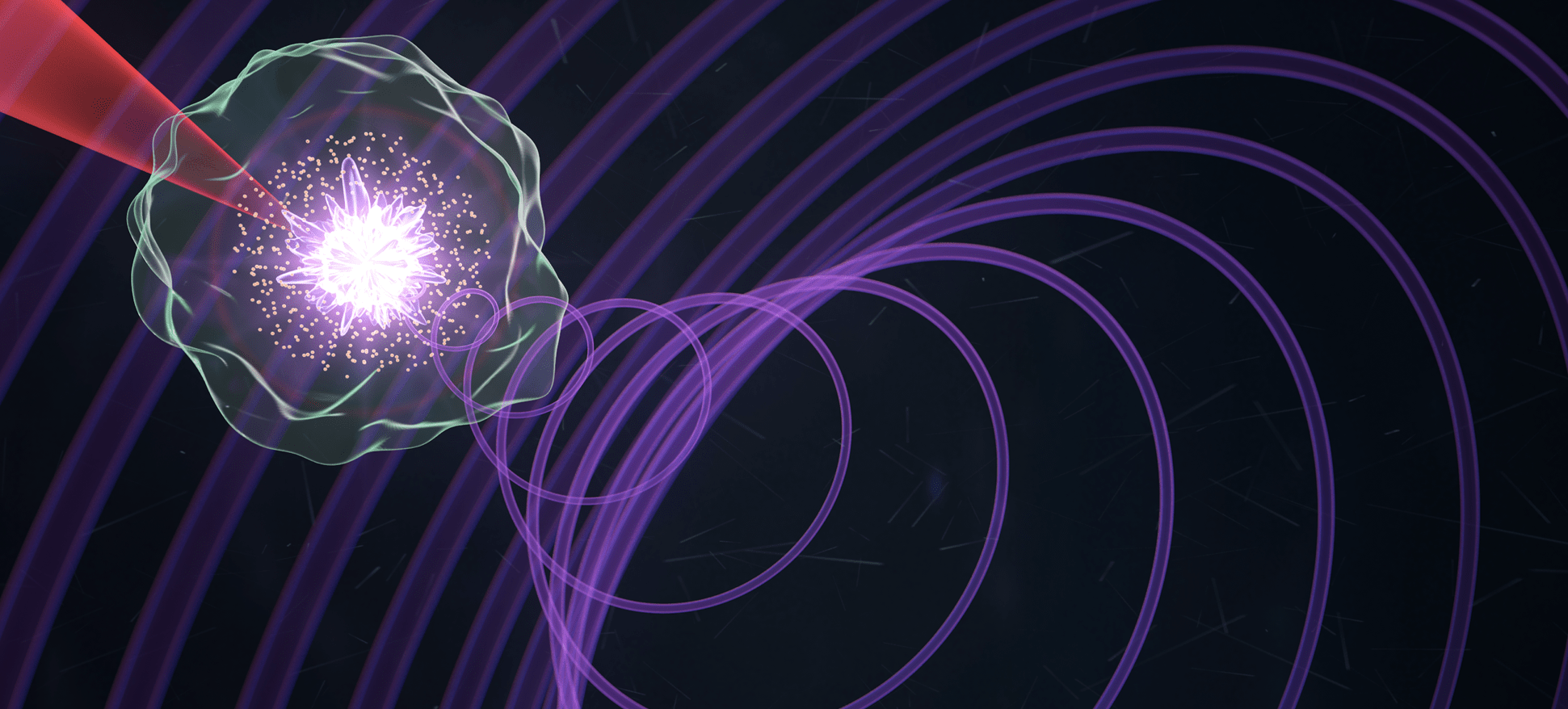
La XIII Reunión Nacional de Óptica (#RNO2021) terminó la semana pasada tras tres dias llenos de interesantes contribuciones y trabajos.  Con mucha pena nos despedimos de esta edición, aunque lo hacemos con una sensación agridulce ya que Ana García Cabrera, estudiante de doctorado y miembro del GIR Aplicaciones Láser y Fótonica fue elegida como la ganadora del premio RNO2021 en la categoría de Óptica Cuántica y No Lineal. Ana, presentó su trabajo «Ultrafast Talbot Spectroscopy» del que es coautora junto con Carlos Hernández – García y Luis Plaja. Puedes leer el resumen a continuación.  Resumen:  La generación de armónicos de orden alto es una herramienta que permite producir radiación coherente de alta frecuencia en forma de pulsos de muy corta duración, que pueden ser empleados para estudiar las propiedades de la materia en escalas nanométricas. Este proceso ocurre durante la interacción de un láser intenso con los átomos de un material. El láser deforma el potencial atómico permitiendo que el electrón escape de este por efecto túnel. Una vez liberado, el electrón es acelerado por el campo del láser y reconducido hacia el átomo ionizado, donde se produce la recombinación y la emisión de radiación en forma de armónicos de la frecuencia del láser incidente. En la escala espacial en la que este proceso tiene lugar, los electrones se comportan como ondas y, por tanto, podemos esperar observar en ellos algunos de fenómenos que observamos típicamente en la luz, como el efecto Talbot, característico de la difracción en campo cercano. El efecto Talbot da lugar a la formación de auto-imágenes a distancias regulares, a partir de una máscara periódica, como una red de difracción. En este trabajo, simulamos un experimento de formación de imágenes Talbot en la función de onda electrónica ionizada durante el proceso de generación de armónicos de orden alto en un cristal. La función de onda periódica del cristal es liberada por el campo del láser y durante su evolución libre, experimenta la formación de auto-imágenes Talbot a lo largo del tiempo. Esto provoca unas modulaciones temporales en la radiación emitida, que dejan una traza en el espectro de armónicos que además es sensible a la ocupación de las bandas en el cristal. Por tanto, proponemos una nueva herramienta, la espectroscopía Talbot ultrarrápida, basada en la ya conocida interferometría Talbot-Lau.  Puedes consultar el articulo que ha publicado sobre este mismo trabajo en el siguiente enlace o descargarlo desde el repostorio institucional de la Universidad de Salamanca GREDOS.  Ana García-Cabrera et al 2021 New J. Phys. 23 093011 ¡Damos nuestra enhorabuena a Ana y al resto de premiados y finalistas del congreso! Todos los detalles del congreso se pueden consultar en su pagina web y su cuenta de Twitter (hashtag #RNO2021)

Participación de ALF-USAL en el RNO2021 – Sesión de poster

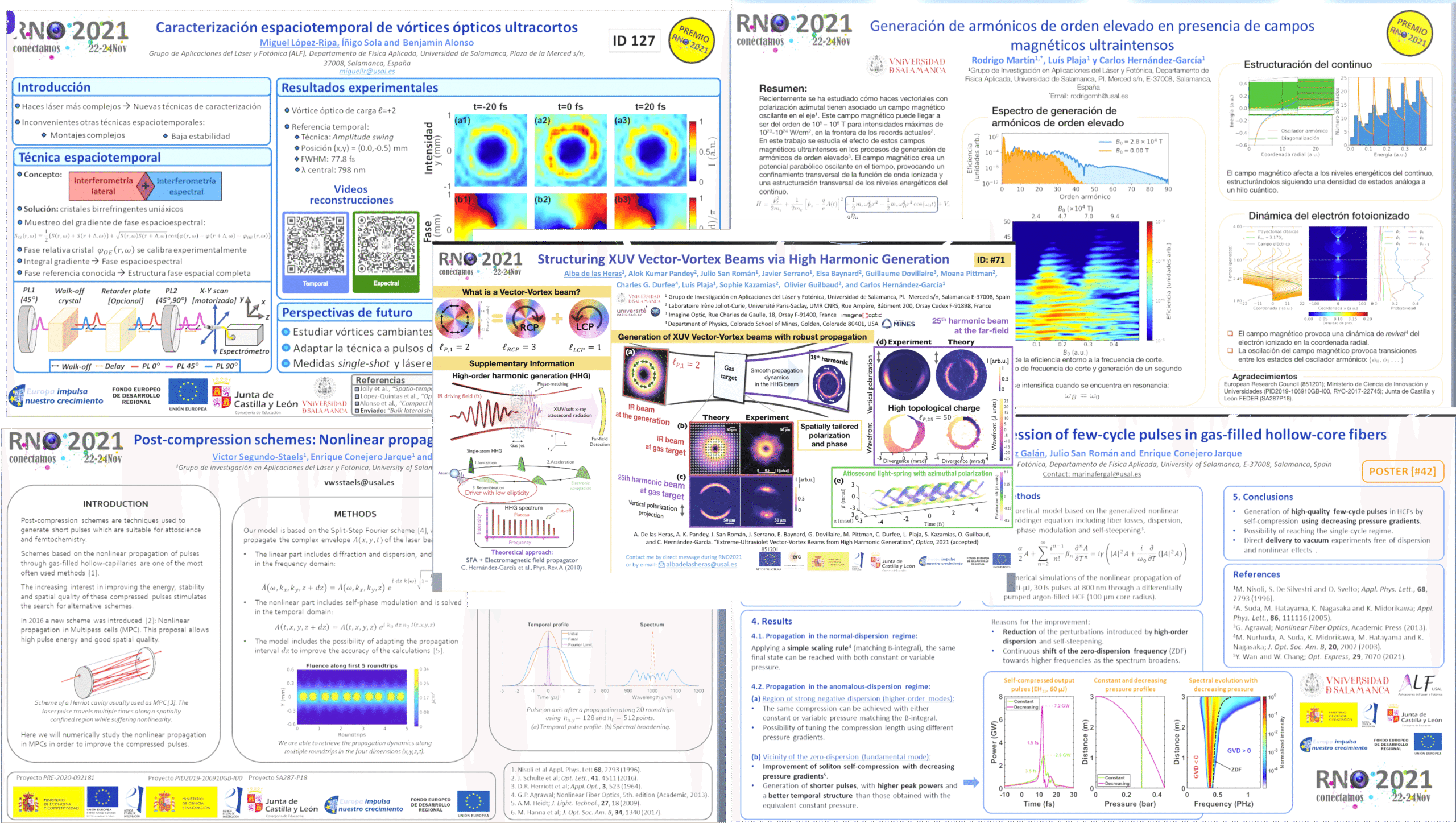
Varios miembros del Grupo de Aplicaciones Laser y Fotonica (ALF – USAL) presentan los resultados de su investigación en las Sesiones de Poster y organizadas durante la XIII Reunion Nacional de Óptica (RNO 2021) que esta teniendo lugar de forma virtual del 22 al 24 de noviembre de 2021.  A continuación se incluyen los trabajos presentados.: Todos los detalles del congreso se pueden consultar en su pagina web. Ademas se podrá seguir el evento a través de la cuenta de Twitter de la XIII Reunión Nacional de Óptica y el hashtag #RNO2021.   Structuring XUV Vector-Vortex Beams via High Harmonic Generation Autores: Alba de las Heras, Alok Kumar Pandey, Julio San Román, Javier Serrano, Elsa Baynard, Guillaume Dovillaire, Moana Pittman, Charles G. Durfee, Luis Plaja, Sophie Kazamias, Olivier Guilbaud, y Carlos Hernández-García Resumen: Structured light in the short-wavelength regime is emerging as a paramount tool to explore ultrafast spin and electronic dynamics. In this work, we demonstrate experimentally and theoretically the up-conversion of Vector-Vortex Beams (VVB) from the IR to the XUV regime, introducing a unique configuration of XUV coherent radiation spatially structured in its polarization and phase. The build-up of high-order harmonic generation driven by VVB is governed by the conservation of the Pancharatnam topological charge, which considers the intertwined spin and orbital angular momentum properties. The selection rule results in harmonic VVB with a high topological charge and smooth propagation dynamics. A new post-compression scheme: nonlinear propagation in multipass cells. Autores:  Victor Segundo-Staels, Enrique Conejero Jarque y Julio San Roman1.  Resumen: Structured light in the short-wavelength regime is emerging as a paramount tool to explore ultrafast spin and electronic dynamics. In this work, we demonstrate experimentally and theoretically the up-conversion of Vector-Vortex Beams (VVB) from the IR to the XUV regime, introducing a unique configuration of XUV coherent radiation spatially structured in its polarization and phase. The build-up of high-order harmonic generation driven by VVB is governed by the conservation of the Pancharatnam topological charge, which considers the intertwined spin and orbital angular momentum properties. The selection rule results in harmonic VVB with a high topological charge and smooth propagation dynamics.

The Lord of the Rings: the Graphene Match

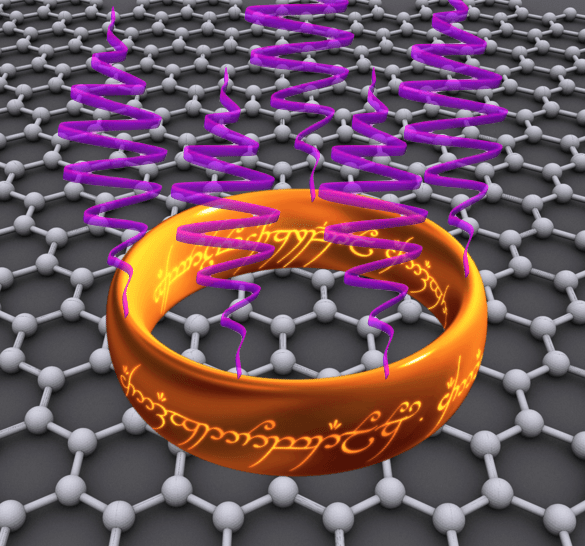
As in the books of JRR Tolkien, the Research Group of Laser Applications and Photonics (ALF-USAL) continues their adventure in the search of the Ring. After finding the Phase-Matched Ring in Argon based High-Harmonic Generation [1], now they’ve gone a step beyond to find the Phase-Matched Ring in graphene. It turns out that when a graphene layer is illuminated by an intense laser beam, ultrafast electronic dynamics result in the emission of higher frequency radiation.  This emission can be understood as a result of an excitation of electrons from the valence to the conduction band, a subsequent acceleration in such conduction band, and a final recombination with the holes that were left in the valence band. Such process, known as high-order harmonic generation, is very sensitive to the intensity of the incoming laser field, and thus to the spatial profile of the beam.  As a consequence, the radiation emitted from different parts of the graphene layer can interfere, both destructively or constructively. It turns out that an adequate matching between the emissions from different parts of the graphene layer is required to obtain bright high-frequency radiation. In their latest work, the ALF-USAL group has demonstrated that when a graphene layer is illuminated by an intense Gaussian beam, the high-order harmonic emission is dominated by an annular region: the Phase-Matched Ring. This finding gives light into the macroscopic physics of high harmonic generation in graphene, offering a tool to engineer the process, and to increase its efficiency. After finding the Phase-Matched Ring in Argon and in Graphene, the researchers of ALF-USAL group continue their adventures to rule intense light-matter interactions.  More information in:  “Transverse phase matching of high-order harmonic generation in single-layer graphene”, Roberto Boyero-García, Óscar Zurrón-Cifuentes, Luis Plaja, and Carlos Hernández-García,  Optics Express 29, 2488-2500 (2021). References: [1] “Carrier-envelope-phase insensitivity in high-order harmonic generation driven by few-cycle laser pulses”, C. Hernández-García, W. Holgado, L. Plaja, B. Alonso, F. Silva, M. Miranda, H. Crespo, and I. J. Sola, Optics Express  23, 21497 (2015) Download in Gredos@Universidad de Salamanca: http://hdl.handle.net/10366/146004  

El señor de los anillos: el ajuste del Grafeno

Como en los libros de JRR Tolkien, el grupo de investigación de Aplicaciones Láser y Fotónica (ALF-USAL) continua su aventura en la búsqueda del Anillo. Tras descubrir el Anillo de Fase Ajustada en la generación de armónicos de orden elevado en Argón [1], ahora han ido un paso mas allá para encontrar el correspondiente Anillo de Fase Ajustada en grafeno. Cuando una lámina de grafeno se ilumina con un haz láser intenso, la dinámica electrónica ultrarrápida inducida da como resultado la emisión de radiación de mayor frecuencia. Esta emisión puede entenderse como resultado de una excitación de electrones desde la capa de valencia a la banda de conducción, una posterior aceleración en dicha banda de conducción, y una recombinación final con los huecos que quedaron en la banda de valencia. Dicho proceso, conocido como generación de armónicos de orden alto, es muy sensible a la intensidad del campo láser incidente y, por lo tanto, al perfil espacial del haz láser. Como consecuencia, la radiación emitida desde diferentes partes de la capa de grafeno puede interferir, tanto de forma destructiva como constructiva. Para obtener radiación de alta frecuencia eficiente es necesario ajustar correctamente las emisiones de las diferentes partes de la lámina de grafeno. En su último trabajo, el grupo ALF-USAL ha demostrado que cuando la lamina de grafeno se ilumina con un haz Gaussiano intenso, la emisión de armónicos de orden elevado se produce esencialmente en una región anular de la lámina: el Anillo de Fase Ajustada. Este hallazgo arroja luz sobre la física macroscópica de generación de armónicos de orden elevado en el grafeno, ofreciendo una herramienta para diseñar el proceso y aumentar su eficiencia. Después de encontrar el Anillo de Fase Ajustada en Argón y en Grafeno, los investigadores del grupo ALF-USAL continúan sus aventuras para gobernar las interacciones luz-materia con láseres intensos. Más información en:  “Transverse phase matching of high-order harmonic generation in single-layer graphene”, Roberto Boyero-García, Óscar Zurrón-Cifuentes, Luis Plaja, and Carlos Hernández-García,  Optics Express 29, 2488-2500 (2021). Referencias:  [1] “Carrier-envelope-phase insensitivity in high-order harmonic generation driven by few-cycle laser pulses”, C. Hernández-García, W. Holgado, L. Plaja, B. Alonso, F. Silva, M. Miranda, H. Crespo, and I. J. Sola, Optics Express  23, 21497 (2015) Descargalo en Gredos @Universidad de Salamanca: http://hdl.handle.net/10366/146004  

XIII NATIONAL OPTICAL MEETING – ALF Participation

The National Meeting of Optics of the year 2021 (RNO2021) will take place next week from November 22 to 24. In this online event that has more than 240 registered people and 19 sponsors, more than 200 scientific contributions will be presented. The National Meeting of Optics (RNO) is a triennial congress organized by the Spanish Society of Optics (SEDOPTICA), which has a long history of more than 30 years. An average of 200 professionals from different specialties of Optics and Photonics in Spain converge in each RNO and it is where the latest scientific and technological advances in this field are presented. The XIII RNO 2021, organized this year by the SEDOPTICA Women, Optics and Photonics Area, aims to maintain the high quality standards of this conference, placing special emphasis on creating a parity and attractive congress for younger researchers. Being one of the main events related to research in the field of optics and photonics, it is an essential appointment in the calendar of the members of the Laser and Photonics Applications Group. This year, the Laser and Photonics Applications Group present the following contributions: Oral Contribution: “Dispersive wave emission at a fixed wavelength through parameter scaling” (#53), A. Crego, E. Conejero Jarque and J. San Roman. Wednesday 24th (15:00 h). Oral: Contribution: «Ultrafast Talbot Spectroscopy», Ana García-Cabrera, Carlos Hernández-García y Luis Plaja. Wednesday 24th (15:00 h). Poster: “Caracterización espaciotemporal de vórtices ópticos ultracortos” (#127), Miguel López-Ripa, Íñigo J. Sola & Benjamín Alonso. Monday 22nd (17:30-18:30h) and Tuesday 23rd (17:00-18:00h) Poster: “Structuring XUV Vector-Vortex Beams via High Harmonic Generation“, (#71). Alba de las Heras, Alok Kumar Pandey, Julio San Román, Javier Serrano, Elsa Baynard, Guillaume Dovillaire, Moana Pittman, Charles G. Durfee, Luis Plaja, Sophie Kazamias, Olivier Guilbaud, and Carlos Hernández–García. Monday 22nd (17:30-18:30h) and Tuesday 23rd (17:00-18:00h) Poster: «Pressure gradients in the compression of few-cycle pulses y gas-filled hollow-core fibers». Marina Fernández Galán, Julio San Román y Enrique Conejero Jarque. Monday 22nd (17:30-18:30h) and Tuesday 23rd (17:00-18:00h) Poster: «Divulgación de la óptica en tiempos de pandemia: actividades online realizadas por la OSAL student chapter.» Ana García-Cabrera, Víctor W. Segundo-Staels, Javier Prada-Rodrigo, Daniel García Carracedo, Alba de las Heras y Laura Rego. Monday 22nd (17:30-18:30h) and Tuesday 23rd (17:00-18:00h) Póster. «SEDOPTICA–MOF: fomentando la igualdad de género«. Rosa Ana Pérez, Ana I. Gómez, Francesca Gallazzi, Beatriz Santamaria, Alba de las Heras, María Baralida Tomás, Verónica González, Martina Delgado, y María Viñas. Monday 22nd (17:30-18:30h) and Tuesday 23rd (17:00-18:00h) In addition, several members of the GIR Laser and Photonics Applications participate in the following spaces within RNO2021: Assembly of the Committee of Quantum Optics and Nonlinear Optics. Monday 22nd (19:30-20:30h). During this assembly, the new Board of Directors of the Committee will be elected. Carlos Hernández – Garcia and Alba de las Heras appear as members of the committee, as president and student member respectively. Round table: Ibero-American Meeting of OPTICA chapters. Wednesday 24th (17:00- 18:00h) RNO Young. Activity «Óptica sin limites«. Tuesday 23rd (14:05-14:55h) (Ana García Cabrera) RNO Young. Activity «Conecta y LúZete«. Tuesday 23rd (14:55-16:00h) (Miguel López Ripa) All the details of the congress can be consulted on its website. You can also follow the event through the Twitter account of the XIII National Optics Meeting and the hashtag #RNO2021.

XIII REUNIÓN NACIONAL DE ÓPTICA – ALF Participación

La Reunion Nacional de Optica del año 2021 (RNO2021) tendrá lugar la próxima semana del 22 al 24 de noviembre. En este evento online que cuenta con mas de 240 personas inscritas y 19 patrocinadores se presentaran mas de 200 contribuciones científicas.  La Reunión Nacional de Óptica (RNO) es un congreso trienal organizado por la Sociedad Española de Óptica (SEDOPTICA), que cuenta con una amplia trayectoria de más de 30 años. En cada RNO confluyen una media de 200 profesionales de diferentes especialidades de la Óptica y la Fotónica en España y es donde se presentan los últimos avances científicos y tecnológicos en este campo.  La XIII RNO 2021, organizada este año por el Área de Mujer, Óptica y Fotónica de SEDOPTICA, tiene como objetivo mantener los altos estándares de calidad de esta conferencia poniendo especial énfasis en crear un congreso paritario y atractivo para los y las investigadoras más jóvenes.  Siendo uno de los principales eventos relacionados con la investigación en el campo de la óptica y la fotonica, es una cita imprescindible en el calendario de los miembros del Grupo de Aplicaciones Laser y Fótónica. Este año, el Grupo de Aplicaciones Láser y Fotónica presentan las siguientes contribuciones:  Contribución Oral: “Dispersive wave emission at a fixed wavelength through parameter scaling” (#53), A. Crego, E. Conejero Jarque and J. San Roman. Miércoles 24 de noviembre (15:00 h). Contribución Oral: “Ultrafast Talbot Spectroscopy”, Ana García-Cabrera, Carlos Hernández-García y Luis Plaja. Miércoles 24 de noviembre (15:00 h) Poster: “Caracterización espaciotemporal de vórtices ópticos ultracortos” (#127), Miguel López-Ripa, Íñigo J. Sola & Benjamín Alonso. Lunes 22 de noviembre (17:30-18:30h) y martes 23 de noviembre (17:00-18:00h) Poster: “Structuring XUV Vector-Vortex Beams via High Harmonic Generation“, Alba de las Heras, Alok Kumar Pandey, Julio San Román, Javier Serrano, Elsa Baynard, Guillaume Dovillaire, Moana Pittman, Charles G. Durfee, Luis Plaja, Sophie Kazamias, Olivier Guilbaud, and Carlos Hernández-García. Lunes 22 de noviembre (17:30-18:30h) y martes 23 de noviembre (17:00-18:00h) Poster: “Pressure gradients in the compression of few-cycle pulses y gas-filled hollow-core fibers”. Marina Fernández Galán, Julio San Román y Enrique Conejero Jarque. Lunes 22 de noviembre (17:30-18:30h) y martes 23 de noviembre (17:00-18:00h) Poster: “Generación de armónicos de orden elevado en presencia de campos magnéticos ultraintensos”. Víctor Segundo-Staels, Enrique Conejero Jarque, Julio San Román. Lunes 22 de noviembre (17:30-18:30h) y martes 23 de noviembre (17:00-18:00h) Poster: “Post-compression schemes: Nonlinear propagation in multipass cells”. Rodrigo Martín, Luis Plaja y Carlos Hernández-García. Lunes 22 de noviembre (17:30-18:30h) y martes 23 de noviembre (17:00-18:00h Póster: “Divulgación de la óptica en tiempos de pandemia: actividades online realizadas por la OSAL student chapter.” Ana García-Cabrera, Víctor W. Segundo-Staels, Javier Prada-Rodrigo, Daniel García Carracedo, Alba de las Heras y Laura Rego. Lunes 22 de noviembre (17:30-18:30h) y martes 23 de noviembre (17:00-18:00h) Póster. “SEDOPTICA-MOF: fomentando la igualdad de género“. Rosa Ana Pérez, Ana I. Gómez, Francesca Gallazzi, Beatriz Santamaria, Alba de las Heras, María Baralida Tomás, Verónica González, Martina Delgado, y María Viñas.  Lunes 22 de noviembre (17:30-18:30h) y martes 23 de noviembre (17:00-18:00h). Ademas, varios miembros del GIR Aplicaciones Láser y Fotónica participan en los siguientes espacios dentro de la RNO2021:  Asamblea del Comité de Óptica Cuántica y Óptica No Lineal. Lunes 22 (19:30-20:30h). Durante esta asamblea se elegirá a la nueva Junta Directiva del Comité. Carlos Hernández – Garcia y Alba de las Heras se presentan como miembros del comité, como presidente y vocal estudiante respectivamente.  Mesa redonda: Encuentro Iberoamericano de OPTICA chapters. Miércoles 24 (17:00-18:00h) RNO Joven. Actividad “Óptica sin limites”. Martes 23 (14:05-14:55h) (Ana García Cabrera) RNO Joven. Actividad “Conecta y LúZete”. Martes 23 (14:55-16:00 h) (Miguel López Ripa) Todos los detalles del congreso se pueden consultar en su pagina web. Ademas se podrá seguir el evento a través de la cuenta de Twitter de la XIII Reunión Nacional de Óptica y el hashtag #RNO2021.  

Optical nanotechnology using electrons.

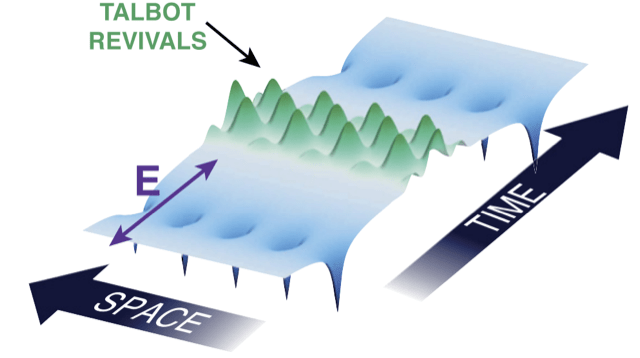
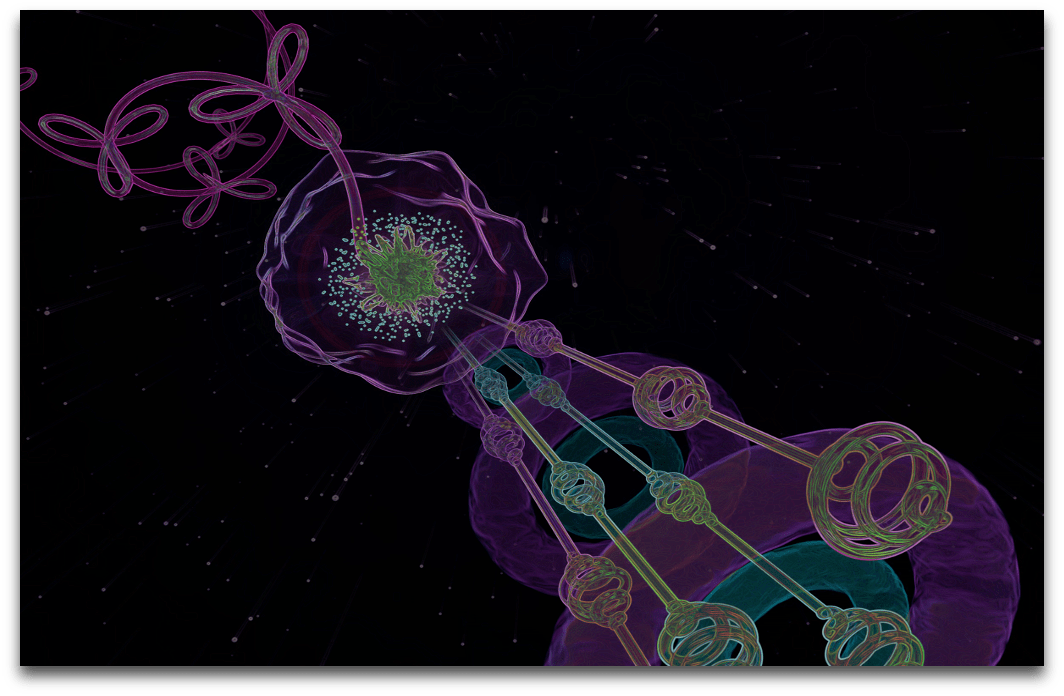
In 1924,  Louis-Victor Pierre Raymond, pair of France  and Duke of Broglie, astonished his contemporaries in proposing that electrons behave as waves,  when moving along spatial dimensions of a few millionths of a milimeters. These distances, dubbed nanometers, remained technologically unaccessible until some decades ago. Roughly speaking, if the electrons appear as waves under these circumstances, we should expect their behaviour close to that of light. One of the most obvious manifestations of the wave nature of light is diffraction, the modification of its structure when passing through small slits. In 1836, the british physicist Henry Fox Talbot observed an extraordinary remarkable diffraction phenomenon: when light passes through a mask composed by a regular disposition of slits, it forms an image of the slits at some particular distances from the mask. This image if formed spontaneously, without he use of any focalizing element as lenses or mirrors. Our study predicts theoretically that this very same effect arises in the electron waves, if the electrons are detached from a periodic crystal due to the interaction with an electromagnetic field. The Talbot imaging effect would allow to control the shape of the electron wave and, therefore, some of the properties of their emission of light. Almost magically, the spatial structure of the Talbot image is codified in the temporal structure of the light emission. All this, of course, at nanometric scales!. More info at:  [1] A. García-Cabrera, C. Hernández-García, and L. Plaja, Ultrafast Sub-Nanometer Matter-Wave Temporal Talbot Effect, New Journal of Physics 23, 093011 (2021). Download in Gredos Universidad de Salamanca  http://hdl.handle.net/10366/147197

Carlos Hernández, Young Scientist Prize In Atomic, Molecular and Optical Physics 2021

On June 8, the researcher Carlos Hernández García received the Young Scientist Prize In Atomic, Molecular and Optical Physics 2021 awarded by the International Union of Pure and Applied Physics (IUPAP) for his: “…outstanding contributions to the theory and modeling of laser-driven high harmonic generation (HHG), both in high photon energy regimes, and in understanding how to manipulate the HHG waveforms to impart orbital and spin photon angular momentum, combining quantum simulations with laser Physics.” You can read the press release published by iUPAP in this link and see the video that Carlos Hernández has recorded for the University of Salamanca where he talks about the main lines of research and activities of the Laser and Photonics Applications group, about the Attostructura project (ERC 851201) and the recent discoveries that have earned it this recognition. Congratulations Carlos! https://www.youtube.com/watch?v=bQofTziHez8

Carlos Hernández, Young Scientist Prize In Atomic, Molecular and Optical Physics 2021

El pasado 8 de junio el investigador Carlos Hernández García recibió el premio  Young Scientist Prize In Atomic, Molecular and Optical Physics 2021 que otorga la International Union of Pure and Applied Physics (IUPAP) por su:  “…outstanding contributions to the theory and modeling of laser-driven high harmonic generation (HHG), both in high photon energy regimes, and in understanding how to manipulate the HHG waveforms to impart orbital and spin photon angular momentum, combining quantum simulations with laser Physics.” Puedes leer la nota de prensa publicada por la iUPAP en este enlace y ver el video que ha grabado Carlos Hernández para la Universidad de Salamanca donde habla de las principales lineas de investigación y actividades del grupo de Aplicaciones Láser y Fotónica, del proyecto Attostructura (ERC 851201) y de los recientes descubrimientos que le han valido este reconocimiento.  ¡Enhorabuena Carlos! https://www.youtube.com/watch?v=bQofTziHez8

Attostructura Seminar: imec’s AttoLab (Kevin Dorney)

On November 12, Kevin Dorney, postdoctoral researcher and MSCA member of the AttoLab laboratory of imec (Interuniversity Microelectronics Center) in Leuven (Belgium) visited the Laser and Photonics Applications group as part of the activities planned in the ERC Attostructura project. Kevin Dorney offered us the seminar entitled “Imec’s AttoLab: Bridging the Gap Between Fundamental Ultrafast EUV Science and Practical Metrologies for the Semiconductor Industry” in which he spoke of the laboratory that they have built in the imec facilities, the infrastructure that forms it and the techniques and capabilities they have. You can see the video of the entire seminar on this page or on our YouTube channel. https://www.youtube.com/watch?v=Ve0dXOoQ02g&t=120s

Nanotecnología óptica con electrones.

En 1924, Louis-Victor Pierre Raymond, par de Francia y duque de Broglie, dejó atónito al sus contemporáneos al proponer que los electrones se comportaban como ondas cuando se analiza su movimiento en espacios de unas pocas millonésimas de milímetro. Estas distancias, que conocemos como nanómetros, han resultado inaccesibles a nuestra tecnología hasta hace pocas décadas. A grandes rasgos, si los electrones aparecen como ondas en estas circunstancias, debemos esperar que su comportamiento sea análogo al de la luz. Una de las manifestaciones más habituales de la naturaleza ondulatoria de la luz es la difracción, es decir, la modificación de su estructura al pasar por rendijas lo suficientemente pequeñas. En 1836, el físico británico Henry Fox Talbot observó un fenómeno de difracción extraordinariamente curioso: cuando la luz atraviesa una máscara compuesta por una serie de rendijas dispuestas regularmente, la luz forma una imagen de las rendijas a una cierta distancia de la máscara. Se trata de una imagen formada espontáneamente, sin necesidad de elementos focalizantes, como lentes, espejos, etc. Nuestro trabajo predice teóricamente que el mismo efecto debe tener lugar en los electrones que se ven separados de un cristal por la interacción de un láser. El efecto de imagen Talbot nos permitiría controlar la forma de la onda electrónica y por tanto, alguna de las propiedades de la luz que emiten. De forma casi mágica, la estructura espacial de la imagen Talbot  se codifica en la estructura temporal de la emisión de luz. Todo ello, por supuesto, ¡a escalas nanométricas! Más información en [1] A. García-Cabrera, C. Hernández-García, and L. Plaja, Ultrafast Sub-Nanometer Matter-Wave Temporal Talbot Effect, New Journal of Physics 23, 093011 (2021). Download in Gredos@Universidad de Salamanca http://hdl.handle.net/10366/147197

Candidatura abierta USAL 4 Excellence

Ya está abierta la primera convocatoria del proyecto USAL4EXCELLENCE. Hasta el 15 de febrero de 2022, los interesados ​​podrán presentar sus postulaciones a través del trámite habilitado en la sede electrónica de la USAL. Toda la información sobre el proyecto y el proceso de preparación / envío de solicitudes está disponible en la web: USAL4EXCELLENCE – USAL 4 Excellence   Fecha limite de solicitud: 15 de Febrero de 2022 Informacion del proyecto El “Programa de la Universidad de Salamanca para Fomentar la Excelencia en la Investigación” (USAL4EXCELLENCE) es una iniciativa de la Universidad de Salamanca (USAL) financiada por el Programa Horizonte 2020 en el marco de las acciones MSCA COFUND y cofinanciada por la Junta de Castilla y León, que tiene como objetivo contratar 40 investigadores experimentados. Con un enfoque “de abajo hacia arriba”, el objetivo general de las becas será reconocer las ideas más brillantes y unir mentes brillantes. USAL4EXCELLENCE proporcionará a los becarios oportunidades de formación y creación de redes que mejorarán su desarrollo profesional y su potencial de liderazgo. Condiciones de la beca Cada beca tendrá una duración de 30 meses, lo que garantiza la implementación adecuada del proyecto.  Los becarios se alojarán en la USAL y tendrán la oportunidad y la libertad de elegir su destino durante dos adscripciones. Por lo tanto, los becarios tendrán un período obligatorio en la USAL durante los primeros 24 meses (a excepción de una comisión de servicio voluntaria que debe iniciarse al menos después de 6 meses en la USAL), y una comisión de servicio obligatoria durante los últimos 6 meses de la beca. A los becarios se les asignará un supervisor y un MENTOR adecuados. USAL4EXCELLENCE ofrecerá apoyo personalizado que ayudará a los becarios a comprender y adoptar las mejores prácticas en investigación. Se espera que todos los becarios asistan a los cursos pertinentes (formación en línea, formación presencial o eventos). Muchos de estos cursos serán impartidos a nivel local por departamentos, facultades e institutos, tanto como parte del programa de enseñanza de la USAL como cursos independientes. Todos estos cursos estarán disponibles en este enlace. Requerimientos de los solicitantes SER INVESTIGADORES CON EXPERIENCIA (ER) Es obligatorio poseer un título de doctorado o al menos cuatro años de experiencia investigadora a tiempo completo antes de la fecha límite de la convocatoria. No se aplicarán restricciones de edad y nacionalidad.   CUMPLIR CON LA REGLA ESTÁNDAR DE MOVILIDAD DE MSCA USAL4EXCELLENCE da la bienvenida a candidatos de cualquier nacionalidad pero que no hayan residido o desarrollado su actividad principal (trabajo, estudios, etc.) en España durante más de 12 meses en los 3 años inmediatamente anteriores a la fecha límite de la convocatoria.   DOMINIO DEL INGLÉS Todos los solicitantes deben dominar el inglés. Por lo tanto, pueden aportar un certificado de competencia en inglés (nivel mínimo C1 medido por MCER, Marco Común Europeo de Referencia para las Lenguas) o, alternativamente, deberán demostrar (solo los 40 candidatos mejor calificados) su dominio del inglés idioma a través de una prueba de dominio del idioma inglés (que no es un certificado oficial) realizada por USAL Language Center. Aunque los candidatos pueden optar por esta segunda opción, el equipo de gestión de USAL4EXCELLENCE animará a todos los candidatos seleccionados a tener disponible un certificado oficial de inglés (nivel mínimo C1) antes de firmar el contrato. Beneficios Al firmar el contrato, los becarios quedarán automáticamente dados de alta en el régimen general del Sistema de Seguridad Social español, que estipula los siguientes beneficios Cobertura asistencial social completa. Pension del estado. Beneficios de desempleado. Baja por maternidad / paternidad de 16 semanas para mujeres y para hombres según la legislación española. Cuando corresponda, la madre o el padre podrán sumarse indistintamente a la licencia de paternidad, después de la semana 7 a partir de la fecha de nacimiento. El contrato de trabajo con la USAL también especifica una serie de beneficios específicos que pueden diferir de otros cargos de la administración pública: Vacaciones: 22 días laborables al año. Control de salud: todos los empleados de la USAL tienen la opción de un chequeo médico cada año, pagado por USAL Cada beca incluye fondos para viajes, gastos de investigación razonables y un salario competitivo. El coste total de una beca es de 4.855 € / mes y el salario neto de la ER rondará los 3.500 € / mes. El salario neto resulta de deducir todas las contribuciones obligatorias a la Seguridad Social (empleador / empleado), así como los impuestos directos (por ejemplo, el impuesto sobre la renta) de los importes brutos. Además, las retribuciones pueden variar anualmente en función de las tarifas de la Seguridad Social. La tarifa indicada anteriormente es para investigadores que trabajan a tiempo completo. Los candidatos interesados deben seguir el proceso de solicitud según se define en la página web del proyecto.

USAL4EXCELLENCE open call

First call for the USAL4EXCELLENCE project is now open. Until February 15, 2022, interested candidates may submit their applications through the procedure enabled in the electronic headquarters of the USAL.  All the information about the project and the process of preparing / sending applications on the project website is available at the web: USAL4EXCELLENCE – USAL 4 Excellence Application deadline: February 15th 2022 Project information The “University of Salamanca Programme to Foster Research Excellence” (USAL4EXCELLENCE) is an initiative of the University of Salamanca (USAL) funded by the Horizon 2020 Programme under MSCA COFUND actions and cofunded by the Junta de Castilla y León, which aims to recruit 40 experienced researchers. Taking a ‘bottom-up’ approach, the overall objective of fellowships will be to recognise the brightest ideas and bring brilliant minds together. USAL4EXCELLENCE will provide fellows with training and networking opportunities that will enhance their career development and leadership potential. Fellowship conditions Each fellowship will last 30 months, assuring proper project implementation. Fellows will be hosted at USAL and they will have the opportunity and freedom to choose their destination for two secondments. Thus, fellows will have a mandatory period at USAL during the first 24 months (except for a voluntary secondment which should be started at least after 6 months at USAL), and a mandatory secondment during the last 6 months of the fellowship. Fellows will be assigned a suitable supervisor and MENTOR. USAL4EXCELLENCE will offer tailored support that will help fellows understand and adopt best practice in research. All fellows will be expected to attend relevant courses (on-line training, face-to-face training or events). Many of these courses will be delivered at a local level by departments, faculties and institutes, both as part of the USAL teaching programme and as standalone courses. All these courses will be available at this link. Fellowship Requirements BE EXPERIENCED RESEARCHERS (ERs) It is mandatory to hold a Doctoral degree or at least four years’ full-time research experience by the time of the call deadline. No age and nationality restrictions will be applied.  COMPLY WITH THE STANDARD MSCA MOBILITY RULE USAL4EXCELLENCE welcomes applicants from any nationalities but they may not have resided or carried out their main activity (work, studies, etc.) in Spain for more than 12 months in the 3 years immediately before the call deadline.  ENGLISH PROFICIENCY All applicants must be proficient in English. Thus, they may upload a certificate of proficiency in English (minimum C1 level as measured by CEFR, Common European Framework of Reference for Languages) or, alternatively, they will have to demonstrate (only the 40 highest ranked candidates) their command over the English language through an English language proficiency test (which is not an official certificate) run by USAL Language Centre. Although candidates may opt for this second option, all selected applicants will be highly encouraged by USAL4EXCELLENCE Management Team to have available an official english certificate (minimum C1 level) before signing the contract. Benefits Upon signing the contract, the fellows will automatically be registered under the general regime of the Spanish Social Security System, which stipulates the following benefits Full social health care coverage. State pension. Unemployment benefits. Maternity/paternity leave of 16 weeks for women and for men according to Spanish law. When applicable, paternity leave could be joined indistinctly by the mother or the father, after week 7 from date birth. The employment contract with USAL also specifies a series of specific benefits that might differ from other public administration positions: Vacation: 22 working days per year. Health Checks: all USAL employees have the option of a medical check every year, paid by USAL Each fellowship includes funds for travel, reasonable research expenses as well as competitive salary. The total cost of a fellowship is 4.855 €/month and the net salary of the ER will be around 3.500 €/month. The net salary results from deducting all compulsory (employer/employee) Social Security contributions as well as direct taxes (e.g., income tax) from the gross amounts. Additionally, the remunerations may vary annually depending on the Social Security rates. The rate indicated above is for researchers working full-time Interested candidates should follow the application process as defined in project web page.

Attostructura Seminario: imec’s AttoLab (Kevin Dorney) – Video

El pasado 12 de noviembre, Kevin Dorney, investigador postdoctoral y miembro MSCA del laboratorio AttoLab del imec (Interuniversity Microelectronics Centre) en Leuven (Belgium) visitó el grupo de Aplicaciones Laser y Fotónica como parte de las actividades previstas en el proyecto ERC Attostructura.  Kevin Dorney nos ofreció el seminario titulado “Imec’s AttoLab: Bridging the Gap Between Fundamental Ultrafast EUV Science and Practical Metrologies for the Semiconductor Industry” en el que habló del laboratorio que han construido en las instalaciones del imec, la infraestructura que lo forma y las técnicas y capacidades de las que disponen.  Podéis ver el video del seminario al completo en esta misma pagina o en nuestro canal de Youtube. 

Attostructura Seminar: Imec’s AttoLab (Kevin Dorney)

Next November 12 at 10:00 in classroom III of the Trilingual building, Kevin Dorney from imec will give the seminar: Imec’s AttoLab: Bridging the Gap Between Fundamental Ultrafast EUV Science and Practical Metrologies for the Semiconductor Industry  High-harmonic generation (HHG) is nature’s most extreme nonlinear process known to date and, for just over 30 years, it has enabled the realization of table-top, short-pulsed extreme ultraviolet (EUV) and soft X-ray sources that are currently defining new paradigms in functional, nanoscale spectroscopy and imaging. After decades of combined theoretical and experimental efforts, the underlying mechanism of gas-phase HHG is well understood and it is now known that the quantum physics behind the HHG process can be exploited to tailor the spectral, temporal, spatial, and angular momentum properties of the emitted short-wavelength light. In parallel, advancements in HHG system design have now resulted in robust, bright, and near turn-key systems for producing tunable, coherent EUV light for advanced metrology applications. In this light, imec has recently installed and commissioned the imec AttoLab, a first-of-its-kind, ultrafast, HHG-based EUV metrology and lithography lab with primary aims of performing high-NA EUV lithography and ultrafast materials characterization.  In this talk, Dr. Kevin Dorney will give an overview of imec’s AttoLab, its infrastructure, and the current and foreseen ultrafast spectromicroscopies that will be deployed for characterization of novel semiconductor materials. In addition to spectroscopy and imaging capabilities, the lithographic capabilities of AttoLab will be presented, as well as the first interference lithography results obtained with a 13.5 nm, HHG-based EUV system. Finally, Dr. Kevin Dorney will give some perspectives and outlook on how HHG-based light sources can further benefit semiconductor metrology and lithography, in particular to the use of structured EUV light for advanced inspection and metrology of devices and materials.  Seminar’s poster can be downloaded here. The video of the seminar will be available on the Youtube account of the Laser and Fotonica Applications group once seminar ends. Presenter bio Kevin Dorney is a postdoctoral researcher and MSCA fellow in AttoLab at imec in Leuven, Belgium. He received B.S. degrees in Biology and Chemistry (2012) as well as an M.S. in Chemistry (2014) from Wright State University (Ohio, USA). In 2019, he earned a Ph.D. in Chemical Physics under the supervision of Profs. Margaret Murnane and Henry Kapteyn in JILA at the University of Colorado Boulder, specializing in the HHG-based generation of structured EUV beams with tailored spin and orbital angular momentum. His current research interests involve the deployment of bright, coherent 13.5 nm EUV light from HHG systems to investigate the ultrafast radiochemistry of the EUV exposure mechanism in photoresists, as well as their use in lithographic processes for resist screening and advanced metrologies to facilitate learning cycles as the semiconductor industry transitions to high-NA EUV lithography. 

PhD Student Position on Theory of Structured Attosecond Pulses

The University of Salamanca (Spain) invites application for a 3,5-year PhD Student position to obtain a PhD degree in Physics, starting in January 2022. The position is part of the project ATTOSTRUCTURA, “Structured attosecond pulses for ultrafast nanoscience”, funded by the European Research Council (ERC) under the European Union’s Horizon 2020 research and innovation program (grant agreement No. 851201), supervised by Dr. Carlos Hernández-García, and with a duration of 5 years. Application period: from November 1st to November 20th 2021 Download info Project information The PhD candidate will enroll the project “Structured attosecond pulses for ultrafast nanoscience” at the Laser Applications and Photonics Research group (ALF-USAL) at University of Salamanca (https://laser.usal.es/alf/en/home/). The candidate will find a dynamic and international working environment, and will enrol in the theoretical group. ALF-USAL is an interdisciplinary Optics research group with expertise in both theory (strong-field physics, nonlinear optics, ultrafast phenomena, attosecond science) and experiments (ultrashort pulse characterization, pulse shaping, photonic crystals, ultrashort micro-machining). The candidate will explore the generation and ultrashort structured pulses and their application in ultrafast magnetism, an emerging field that is opening exciting scenarios in laser-matter interaction at the most fundamental level, merging the fields of Optics and Magnetism.   Some of the recent results have been published in high impact factor scientific journals:   – “Generation of extreme-ultraviolet beams with time-varying orbital angular momentum”, L. Rego, K. M. Dorney, N. J. Brooks, Q. Nguyen, C-T. Liao, J. San Román, D. E. Couch, Allison Liu, E. Pisanty, M. Lewenstein, L. Plaja, H. C. Kapteyn, M. M. Murnane, C. Hernández-García, Science 364, eaaw9486 (2019). Highlighted in the media: Physicists discover croissant-shaped twists of light. National Geographic (USA) Twisted light gains angular momentum through ‘self-torque’. PhysicsWorld (UK) Descubierta una nueva propiedad de la luz. El País (Spain) Físicos españoles descubren una nueva propiedad de la luz. El Mundo (Spain) – “Controlling the polarization and vortex charge of attosecond high-harmonic beams via simultaneous spin-orbit momentum conservation”, K. M. Dorney, L. Rego, N. Brooks, J. San Román, C-T. Liao, J. L. Ellis, D. Zusin, C. Gentry, Q. Nguyen, J. M. Shaw, A. Picón, L. Plaja, H. C. Kapteyn, M. M. Murnane, C. Hernández-García, Nature Photonics 13, 123–130 (2019). – “Ultraintense femtosecond magnetic nanoprobes induced by azimuthally polarized laser beams”, M. Blanco, F. Cambronero, M. T. Flores-Arias, E. Conejero Jarque, L. Plaja, C. Hernández-García, ACS Photonics 6, 38–42 (2019) Job profile The candidate will explore the application of ultrashort structured pulses in ultrafast magnetism, an emerging field that is opening exciting scenarios in laser-matter interaction at the most fundamental level, merging the fields of Optics and Magnetism.    Job Functions Development of theoretical methods to describe the generation of femtosecond and attosecond structured laser pulses, using state-of-the-art high-performance computing techniques. Theoretical studies of the manipulation of magnetic properties, using structured laser pulses at the femtosecond and attosecond timescales. Exploration of theoretical models for the non-paraxial description of structured attosecond beams, and their interaction with single atoms and solid systems. Candidate Requirements University degree in Physics. Master program, Physics-related. Advanced level of English: higher than B2 according to the Common European Framework of Reference for Languages or equivalent. Candidates should be able to demonstrate a promising track record of achievements appropriate to their career stage. Contract conditions Type of contract: PhD contract. Limited to 3,5 years, until the end of the project. Contract to be renewed annually. Full-time employee (37,5 hours a week) Economic compensation: Gross salary of: 1.300 €/month (14 salaries), during the first and second years. 1.384 €/month (14 salaries), during the third year. 1.702 €/month (14 salaries), during the fourth year. Research Project: ATTOSTRUCTURA, “Structured attosecond pulses for ultrafast nanoscience”, funded by the European Research Council (ERC) Workplace: Laser Applications and Photonics Research group (ALF-USAL) at University of Salamanca (https://laser.usal.es/alf/en/home/), Spain. Estimated starting date: January 2022. Interested candidates can consult the detailed information of the call, and the submission process on the website of the University of Salamanca (Here) SELECTION PROCESS The selection process is governed by the principles of publicity, equality, merit, and ability, constituting the effect one selecting body composed of representatives of the group of research of USAL. Details of the selection process can be consulted on the call document, available at the University of Salamanca website  SELECTION COMMISSION The selection commission will be made up by Dr. Carlos Hernández-García, and two members of the research team Laser Applications and Photonics Research group (ALF-USAL) at University of Salamanca. More information about the project, the position and the application process can be found Euraxess web page.  More info