
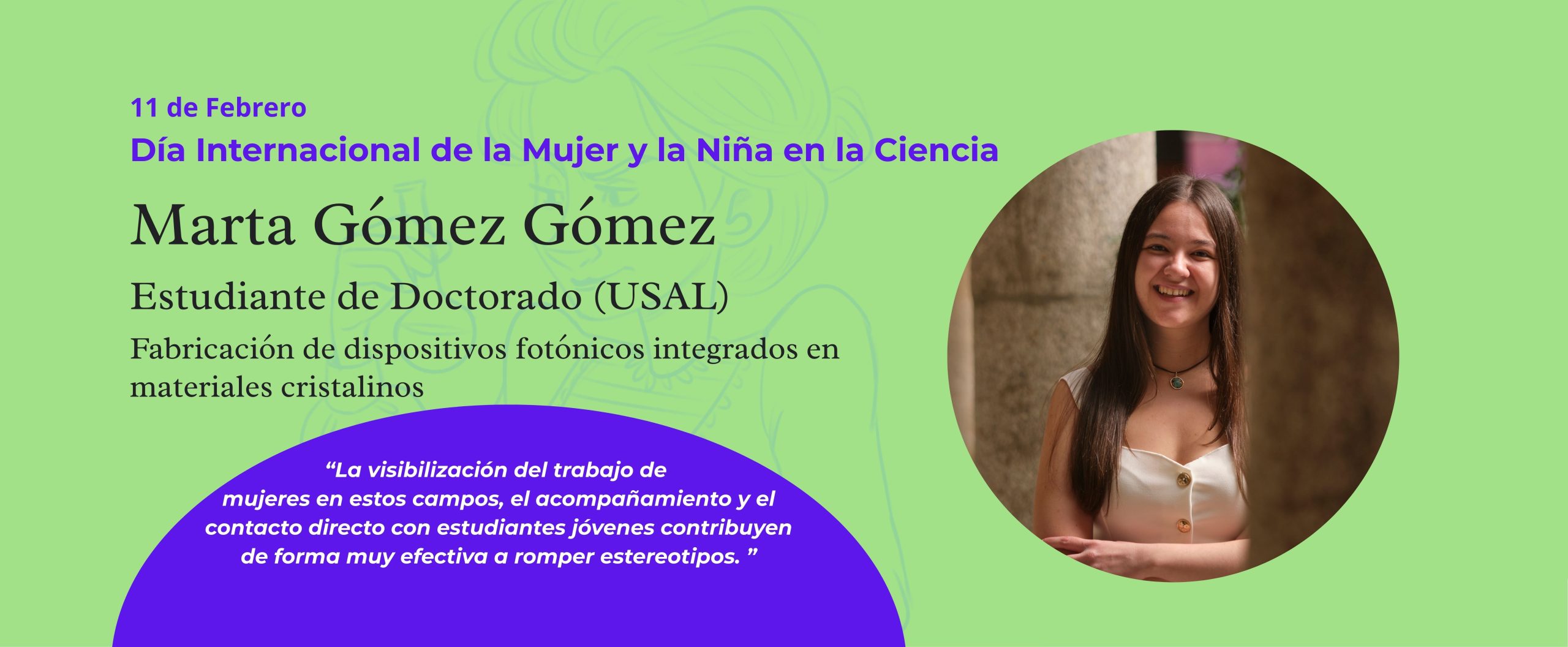
Marta Gómez Gómez is a predoctoral researcher and is developing her doctoral thesis in the Laser and Photonics Applications Research Group (ALF). Her research focuses on the fabrication of photonic devices integrated into crystalline materials using femtosecond laser irradiation and on the study of their nonlinear properties.
This interview was originally conducted by the Women’s Area of SEDOPTICA. The excerpts shown here are published with Marta’s permission. Click here to see the full interview. This interview was originally conducted in Spanish and translated using an automatic translator. Spanish here
Tell us a little about your current line of research
My doctoral research focuses on the fabrication of photonic devices integrated into crystalline materials that allow for advanced control of light properties, such as wavelength, spatial mode, surface interaction, and nonlinear interactions. To achieve this, I employ direct writing using femtosecond laser pulses, which enables highly precise modification of the interior of these materials and the creation of three-dimensional microstructures within them.
One of the main objectives of my thesis is to advance the design and fabrication of waveguide-like elements that integrate 3D microstructures capable of enhancing both the linear and nonlinear behavior of the material, with the aim of developing miniaturized photonic devices with improved functionality.
What inspired you to choose a career in science or research?
From a young age, I’ve always been very curious and have especially enjoyed mathematics. My interest in physics began to take shape in secondary school, when my teacher organized a science fair focused on different areas of physics. We worked in groups and had to explain the concepts through simple experiments, which allowed me to discover how much I enjoyed experimental physics. That experience was key in my decision to study for a degree in Physics.
That interest was reinforced shortly afterward when I participated in a FECYT Summer Science Camp at the Polytechnic University of Cartagena, entitled “The Mystery of Starlight.” During that week, I had my first in-depth experience with optics: from image formation and the use of CCD cameras attached to telescopes, to experiments on the nature of light, measuring its speed in different media, and various technological applications. It was a very comprehensive and highly experimental experience, which made optics particularly appealing to me.
In high school, I confirmed that physics was the discipline that best suited my interests because it allowed me to describe and understand the world using mathematics, which I had always enjoyed. Later, during my undergraduate studies, this interest in optics solidified in my third year thanks to optics courses and, especially, the laboratory work.
What do you enjoy most about your day-to-day life as a scientist?
The work environment is very good and the relationship with my colleagues is excellent, something that especially motivates me and makes me want to go to the lab every day and really enjoy my work.
Which part do you find the most difficult or challenging?
The least rewarding part is related to the uncertainty associated with a research career and some administrative tasks, which sometimes take time away from the scientific part of the work, which is what I really enjoy.
What obstacles have you faced as a woman in the scientific or academic field?
In my own experience, I’m fortunate that I haven’t felt I’ve faced additional difficulties as a woman in the scientific field, or at least I haven’t been aware of them. However, this doesn’t mean they don’t exist. It remains a very real issue, and I know colleagues who have had more challenging experiences throughout their careers.
In the outreach activities we carry out with OSAL in schools and institutes, I’ve had the opportunity to speak directly with girls who are considering studying these fields but who express fear of not fitting in or that it will be too difficult. In these conversations, they’re often interested in my personal experience, which highlights the importance of having relatable and accessible role models.
What kind of actions or changes do you think could improve the participation and visibility of women in science?
I believe one of the reasons there are still fewer women in fields like mathematics, physics, and engineering has to do with the perception many girls and young women have of these disciplines. They are often still seen as very difficult careers or as fields that “aren’t for them,” an idea that is internalized from a young age and can decisively influence their academic choices.
Therefore, I believe that initiatives like those promoted by the Women in Optics and Photonics Area of SEDOPTICA are fundamental. Making the work of women in these fields visible, providing support, and maintaining direct contact with young students contribute very effectively to breaking down stereotypes and helping more girls feel capable and motivated to pursue scientific and technological careers.
I spend a lot of time planning and conducting experiments, but also interpreting the results and trying to understand the underlying physical phenomena, which leads me to continually learn new things
Marta Gómez Gómez