
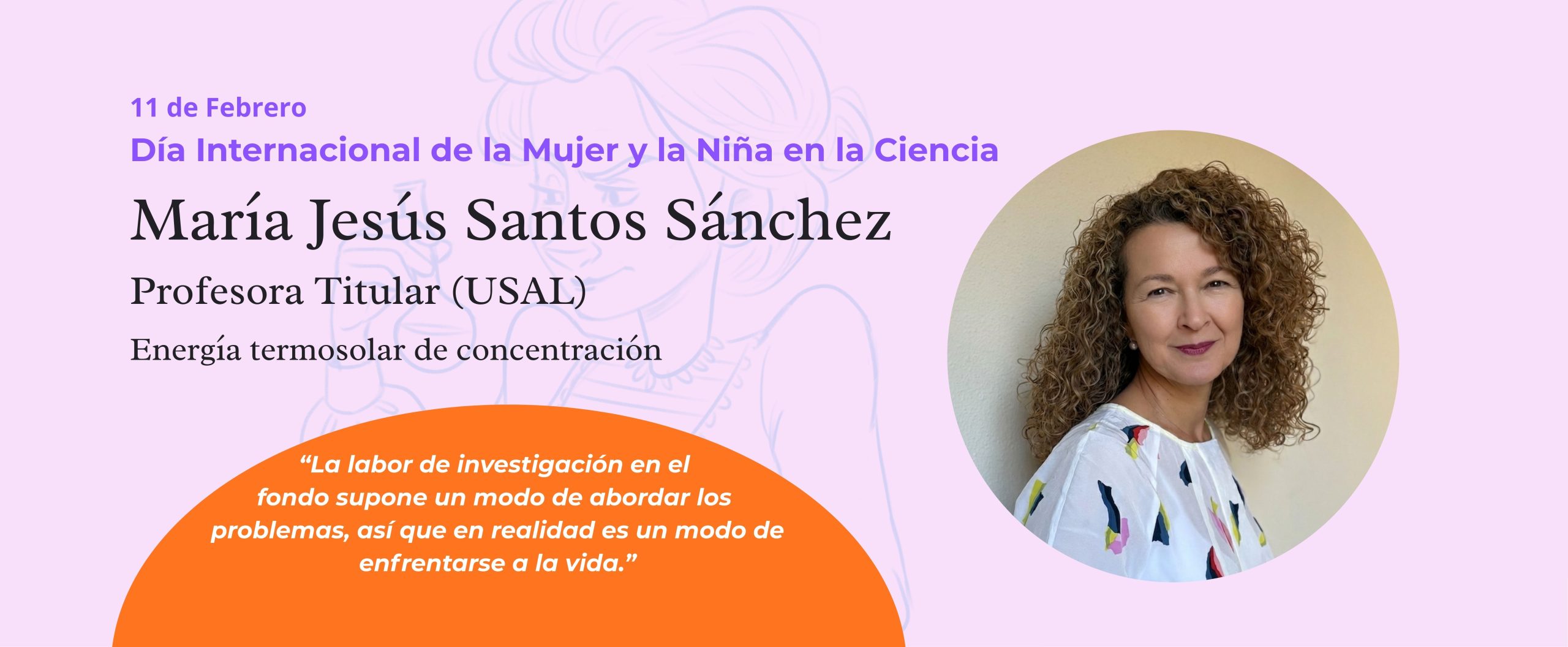
María Jesús Santos Sánchez holds a PhD from the University of Salamanca and is a tenured professor in the Faculty of Sciences. She conducts research in the area of concentrated solar thermal energy.
This interview was originally conducted in Spanish and translated using an automatic translator. Original here
Tell us a little about your current line of research
I am currently involved in two lines of research: teaching practice and physics.
• Research in teaching applied to university education, which is fundamental to ensuring the quality of student training. I strive to incorporate active and innovative teaching methodologies into my teaching practice.
• Research in physics, specifically in concentrated solar power (CSP), which involves harnessing the sun’s heat to produce electricity on a large scale. This is achieved using optical systems that concentrate direct solar radiation onto a small surface area to reach high temperatures. The basic operation is similar to that of a conventional thermal power plant, but instead of burning fossil fuels, it harnesses the sun’s heat. A key advantage of these systems is that CSP plants can incorporate thermal energy storage systems, allowing them to store the generated heat for a period of time to continue producing electricity at night or on cloudy days.
What inspired you to choose a career in science or research?
We all have some special qualities, some skills we excel at. In elementary and high school, I was very good at math, physics, and art. I hesitated between studying math or physics, and finally chose physics because it was a way to combine both disciplines.
What do you enjoy most about your day-to-day life as a scientist?
Research, at its core, is a way of approaching problems, so it’s really a way of facing life. I think I enjoy all the phases. The first is the learning phase, because you have to read and understand what other scientists have done previously in the field of interest. Then there’s the day-to-day work of moving forward, taking small steps that don’t always work, but certainly also help in understanding the phenomenon being studied, learning from mistakes. And of course, there’s the achievement of reaching the objectives initially set for the study, and verifying the hypotheses that were once considered valid. Throughout the entire process, teamwork is key for me, as is the richness that each researcher brings through their characteristics, training, and styles of tackling challenges.
Which part do you find the most difficult or challenging?
The most challenging part is starting a project. Thinking about a situation we haven’t addressed before and designing a path to try and resolve it. That vertigo of facing a new, unexplored challenge.
Is there any achievement or project that you are particularly proud of?
For me, two elements stand out: first, seeing that some of what we develop can be useful, as in our case, taking steps to make concentrated solar power more efficient and competitive.
Second, creating a school of thought, that is, seeing how young people become interested in the work we do in the Energy Optimization, Thermodynamics, and Statistical Physics Group and complete their undergraduate, master’s, and doctoral theses with us. I consider the defense of a doctoral dissertation a day of scientific celebration.
What obstacles have you faced as a woman in the scientific or academic field?
I believe that the world of academia, and science in particular, is kinder in this respect than other fields. Although gender discrimination is linked to a person’s beliefs, regardless of their profession.
Among my colleagues in my field, I haven’t felt discriminated against at all; quite the opposite. However, throughout my career, I have encountered situations of rejection or belittling that I’m sure wouldn’t have occurred if I were a man. The worst part is when that belittling comes from a woman. We must continue working towards equality, in a rational way, without harming ourselves, as is happening to some extent right now with parity laws in fields like Physics, where historically the number of female professionals (compared to men) has been lower.
What kind of actions or changes do you think could improve the participation and visibility of women in science?
It’s true that the proportion of women in Physics is lower than that of men. In fact, in recent years, at the University of Salamanca, only one-third of the Physics students are women. I think we should analyze the reasons for this, which are surely numerous and complex.
One thing we can do, those of us who research Physics, whether men or women, is to publicize our work, to show young people that it’s attractive and interesting, and that through Physics we can contribute to improving the world around us.
What advice or message would you like to share with girls and young women who dream of pursuing a career in science?
An important factor is that we must believe in ourselves. And for this reason, I believe it’s essential to give girls role models, women, in all fields, not just in science.
Listen to the song “Color Esperanza” by Diego Torres and make it your own: “Knowing that it’s possible. Wanting it to be possible. Overcoming fears. Bringing them out into the open.”
If you could describe science in one sentence, what would it be?
It is impossible to imagine technological and therefore social development without scientific knowledge. It's that simple.
María Jesús Santos Sánchez