EU (ATTOSTRUCTURA ERC), National (PID2022-142340NB-I00)
Theses
One in progress
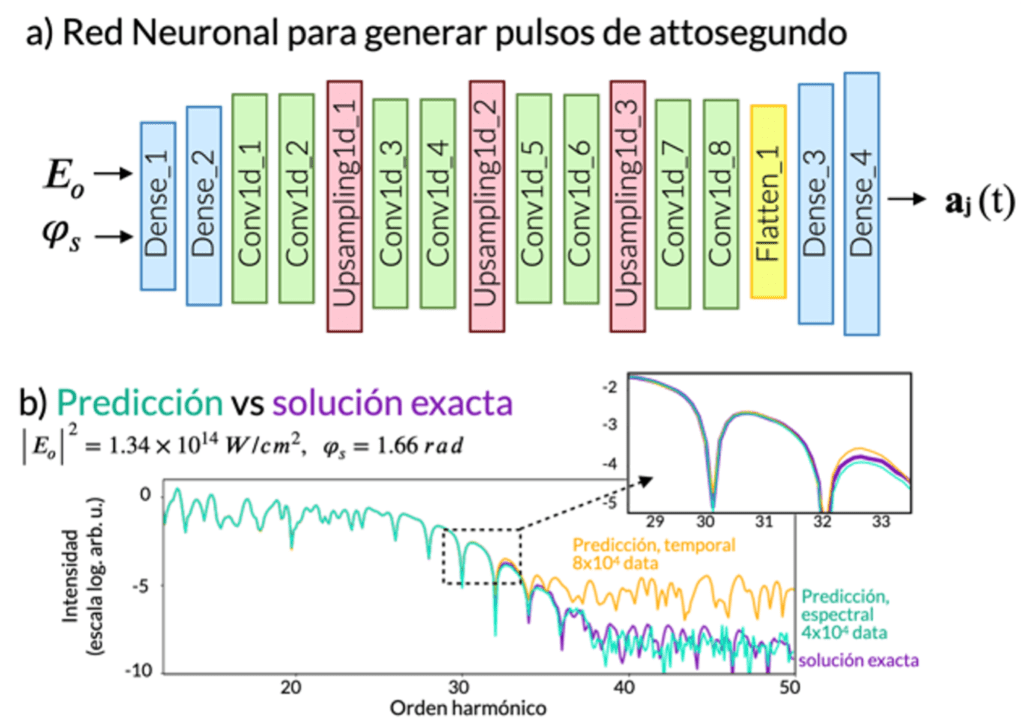
A) Neural network architecture used to predict attosecond pulse generation.
B) Prediction vs exact solution of the generated harmonic spectrum. Fig. adapted from [Comm Phys Comms 291, 108823 (2023)].
Nonlinear optics and materials science, like most cutting-edge research areas, have not been unaffected by the development of artificial intelligence. In the LUMES environment, we have applied deep learning strategies in two main aspects. Firstly, we have implemented the use of neural networks to enhance our simulation capabilities for laser-material interaction. In a recently published article [Comp Phys Comms 291, 108823 (2023)], we have laid the foundations for integrating artificial intelligence to simulate new scenarios of structured light generation in the X-ray regime. This advancement not only accelerates the simulations we have been conducting to deepen our understanding of laser-material interaction but also allows us to explore new scenarios where traditional simulations may struggle due to high computational loads.
Secondly, we are exploring the use of neural networks for the spatiotemporal characterization of ultrashort pulses. The time required by algorithms used in ultrashort pulse characterization techniques currently limits their use in high-repetition-rate laser systems. Thanks to the implementation of neural networks, the required times can be reduced by several orders of magnitude. Therefore, we are currently investigating the possibility of characterizing structured ultrashort pulses in situ in high-repetition-rate laser systems. This research line has developed in parallel with lines #1 and #3. Although it is in its early stages, due to its interdisciplinary nature and the numerous innovative perspectives it opens up, we believe it will become a relevant research line in the near future of LUMES.