
Nonlinear propagation of structured laser beams
principal investigators
senior investigators
phd students
Publications
Projects related
| Publications related (most relevant) | Scientific Reports 8, 2256 (2018), Optics Express 26, 6345 (2018), Optics Letters 43, 337 (2018), Optics Letters 47, 5289 (2022), Optics Express 30, 6755 (2022), Optica 9, 71 (2022), Science Advances 8 (2022) |
| Projects related | National (PID2019-106910GB-I00, PID2020-119818GB-I00, FIS2016-75652-P), Regional (SA287P18) |
| Theses | Two defended, three in progress |
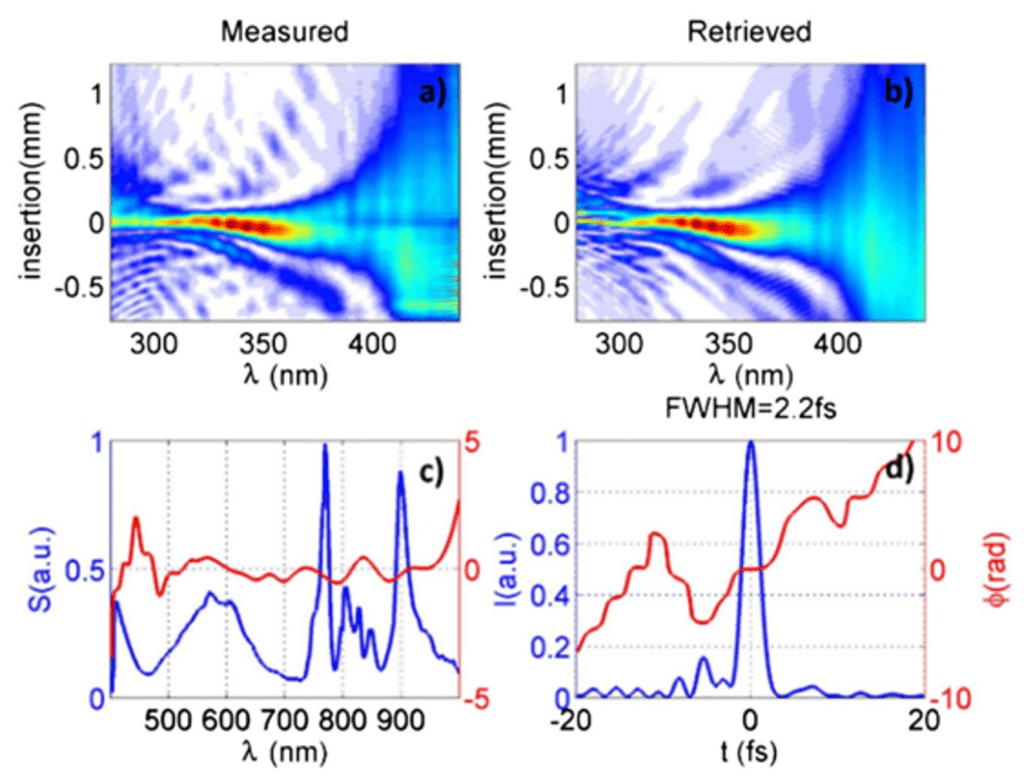
In addition to the generation and characterization of structured laser beams, their propagation becomes especially relevant not only for transporting pulses to potential experiments but also for modifying their properties. For over a decade, USAL has been a pioneer in the development of theoretical methods that allow understanding the propagation of ultrafast laser pulses in highly nonlinear media across different spectral regions (far-infrared, infrared, and ultraviolet). In particular, during this period, it has specialized in the study of the nonlinear propagation of light pulses in gas-filled hollow fibers, which can be structured based on the superposition of transverse modes. Noteworthy are the collaborative works with Prof. Helder Crespo at the University of Porto (Portugal), where ultrarapid single-cycle pulses have been achieved [Opt. Lett. 43, 337 (2018), >50 citations; Sci. Rep. 8, 2256 (2018), >40 citations].
Simultaneously, the nonlinear propagation has been studied in antiresonant hollow fibers and multipass cells, in an experimental collaboration with the research group led by Professors Henry Kapteyn and Margaret Murnane at JILA, University of Colorado in Boulder.
Over the past year, in collaboration with the research groups of Professors Matteo Luchinni and Rocío Borrego-Varillas at Politecnico di Milano (Italy) and Professor Travers at Heriot-Watt University, Edinburgh (Scotland), the results on few-cycle pulses propagating through pressure-gradient fibers have been extended [Opt. Exp, 30, 6755 (2022)] towards the generation of high-order harmonics, aiming to produce few-cycle attosecond pulses. Currently, there are two manuscripts submitted for review.