National (FIS2017-87970-R, PID2020-119818GB-I00), Regional (SA287P18, SA136-P20, PC-TCUE18-20_050, PC-TCUE18-20_020)
Patents
US2022407279, US11035737, US11105687, US10651619
Theses
One defended, two in progress
Experimental setup and results of the characterization of vectorial laser beams in the extreme ultraviolet through the high harmonic generation process. Extracted from [Optica 4, 520 (2017)].
The generation of structured laser pulses with increasingly exotic space-temporal profiles is closely linked to the development of characterization techniques, making this interdisciplinary research line crucial in LUMES. Several researchers in the unit are international references in the development of ultrashort pulse characterization techniques. In addition to designing new characterization techniques in the visible and infrared spectra (such as the STARFISH technique), they are pioneers in the characterization of structured pulses in the extreme ultraviolet. In this regard, the article [Optica 4, 520 (2017), >80 citations] is an international reference for the generation and characterization of vectorial X-ray pulses. This work was developed in collaboration among several unit members, where numerical calculations were performed on the USAL cluster, and experiments were conducted at the Center for Pulsed Lasers (CLPU). Therefore, this is an example of collaboration between researchers and associated infrastructures, now integrated within the LUMES unit.
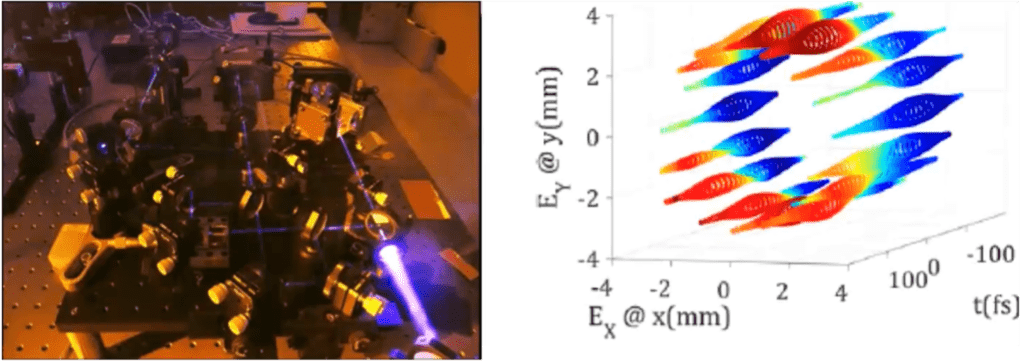
During the reported period, the work of this research line has focused on the development of spatiotemporal and polarization characterization techniques for structured ultrashort pulses. To achieve this, existing techniques (such as STARFISH) have been adapted to the new spatial characterization requirements, or new techniques (such as BLASHI) have been developed. Notable results have been published in [Communications Physics 3, 151 (2020)], where a comprehensive characterization of ultrafast vectorial pulses is reported, or [Photon. Res. 10 922–931 (2022)], where the characterization of structured ultrafast vortices in time is introduced.
Currently, there are several active synergies within LUMES for the development of advanced diagnostic tools for high-power lasers. These collaborations have not yet resulted in scientific publications, and there is co-supervision of a doctoral thesis focused on the development and use of high-power laser characterization tools.
Assembly of a compact ultrafast characterization system, and an example of the reconstruction of a structured ultrafast vector pulse, extracted from [Communications Physics 3, 151 (2020)]