
Generation of High-frecuency structured laser pulses in the femto and attosecond timescales
principal investigators
senior investigators
phd students
Publications
Projects related
| Publications related (most relevant) | Nature Photonics 12, 349 (2018), Science 364 (2019), Nature Photonics 13, 123 (2019), Science Advances 7 (2021), Optica 9, 71 (2022), Science Advances 8 (2022) |
| Projects related | EU (ATTOSTRUCTURA ERC2019), National (PID2019-106910GB-I00, PID2022-142340NB-I00, FIS2016-75652-P), Beca Leonardo BBVA 2017 |
| Theses | One defended, two in progress |
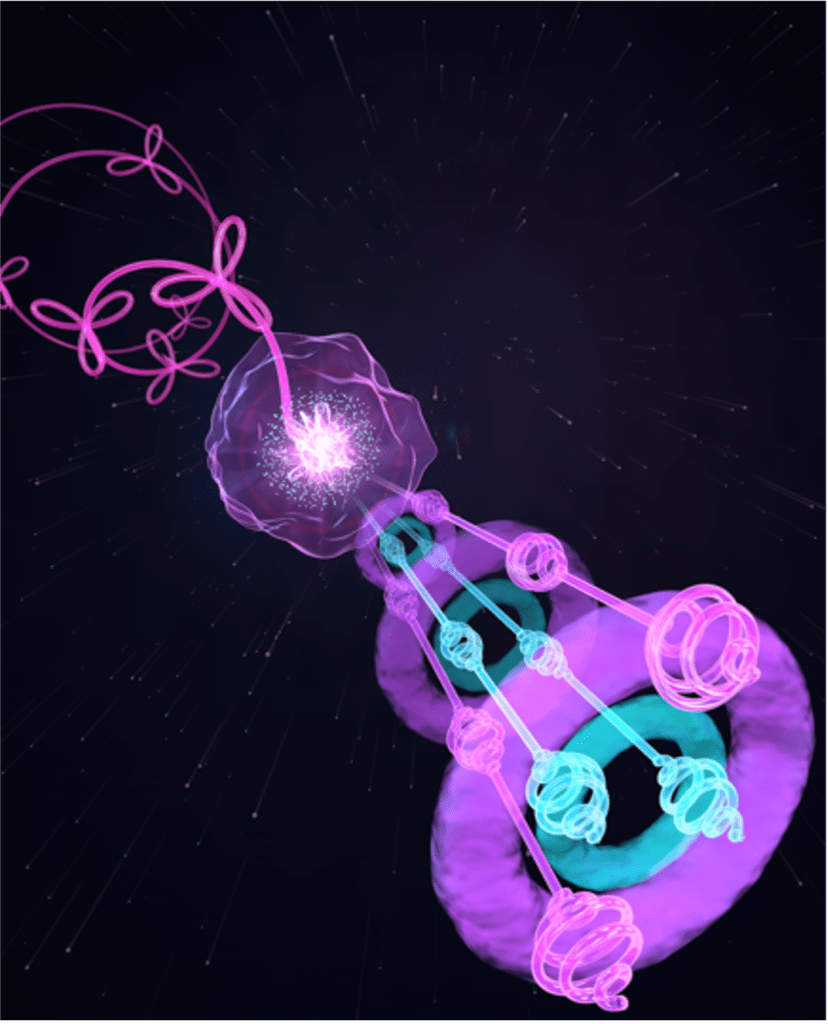
During the last few years, high-frequency laser radiation has emerged as the only tool capable of enabling the observation and manipulation of nature on both the shortest time scales (attoseconds) and the smallest spatial scales (nanometers). The University of Salamanca (USAL) has been a pioneer in the development of structured high-frequency laser light sources with unique properties in the temporal, spatial, and polarization domains. Since 2009, USAL has been engaged in theoretical simulations at the forefront of knowledge in theoretical modeling. These simulations provided support for two pioneering experiments conducted by the research group led by Profs. Henry Kapteyn and Margaret Murnane at JILA, University of Colorado Boulder (USA): the prediction of the temporal emission of the most energetic X-rays generated through the high harmonic generation process [Science 336, 1287 (2012), >1900 citations], and the proposal to generate X-rays from ultraviolet light [Science 350, 1225 (2015), >200 citations]. Furthermore, before the period outlined in this report (2018-2022), the theoretical predictions developed by researchers at the unit were experimentally validated at USAL [for example, Phys. Rev. A 88, 043848 (2013), Opt. Exp. 23, 21497 (2015), Optica 4, 520 (2017)].
These efforts have positioned USAL, particularly LUMES, in a privileged position to conduct research in the emerging field of ultrafast structured light. The focus of the study is on generating high-frequency structured light beams (extreme ultraviolet or even X-rays) with ultra-short durations in the attosecond range. While generating structured laser beams in the visible or infrared range is feasible using optical devices based on light reflection or refraction, shaping such light at higher frequency ranges is challenging, as optical materials progressively become inefficient beyond the ultraviolet. The production of structured light beyond the visible spectrum, therefore, requires a paradigm shift. In 2013, several unit researchers proposed high harmonic generation as a method for the direct production of high-frequency structured radiation, an alternative to imprinting structure on already produced ultraviolet beams. The work [Hernández-García, Phys. Rev. Lett. 111, 083602 (2013), >210 citations] was subsequently experimentally confirmed and is now recognized as a pioneer in the new paradigm for generating high-frequency structured beams.
Noteworthy collaborations published in high-impact journals during the 2018-2022 period, deepening the use of nonlinear optics for the production of structured light beams, include: the generation of isolated circularly polarized attosecond pulses, in collaboration with the group of Prof. Ming-Chang Chen at Tsing Hua Univ. in Taiwan [Nature Photonics 12, 349 (2018), >150 citations]; the discovery of a new property of light beams, self-torque, led by USAL in collaboration with the Kapteyn-Murnane group at JILA, Univ. Colorado Boulder [Science 364 (2019), >200 citations], with broad impact in the public interest (National Geographic, BBC News, El País, El Mundo, etc.); the generation of X-ray vortex beams in collaboration with the Kapteyn-Murnane group at JILA [Nature Photonics 13, 123 (2019), >140 citations] and their understanding in terms of torus-knot angular momentum, in collaboration with ICFO [Phys. Rev. Lett. 122, 203201 (2019), >50 citations]; the generation of vectorial vortex beams in the extreme ultraviolet in collaboration with the group of Prof. Kazamias at Univ. Paris-Saclay [Optica 9, 71 (2022), >30 citations]; or the generation of harmonics with controllable spectral content in X-rays in collaboration with the Kapteyn-Murnane group at JILA [Science Advances 8, (2022), >20 citations]. Researchers from LUMES have collaborated in all these works.
On the theoretical front, contributions have been made to alternative pathways in the field of harmonic generation and electron generation using nanostructures with high conductivity to amplify and modify the laser field at the interaction point with the gas, making electron recombination more effective [PRL 110, 053001 (2013) >100 citations, Rep. Prog. Physics 80, 054401 (2017) >250 citations]. It should be noted that experimentally, this approach is still a challenge as the materials used tend to melt due to the high laser fluence. This problem can be addressed by using ceramic materials, although these materials have very low conductivity, making them inefficient as well. In this scenario, the development of synthetic materials that can withstand high laser fluences while having high conductivities would represent a quantitative leap in the field of high harmonic generation, with implications for structured light, ultrafast magnetism, and more broadly, attophysics.