
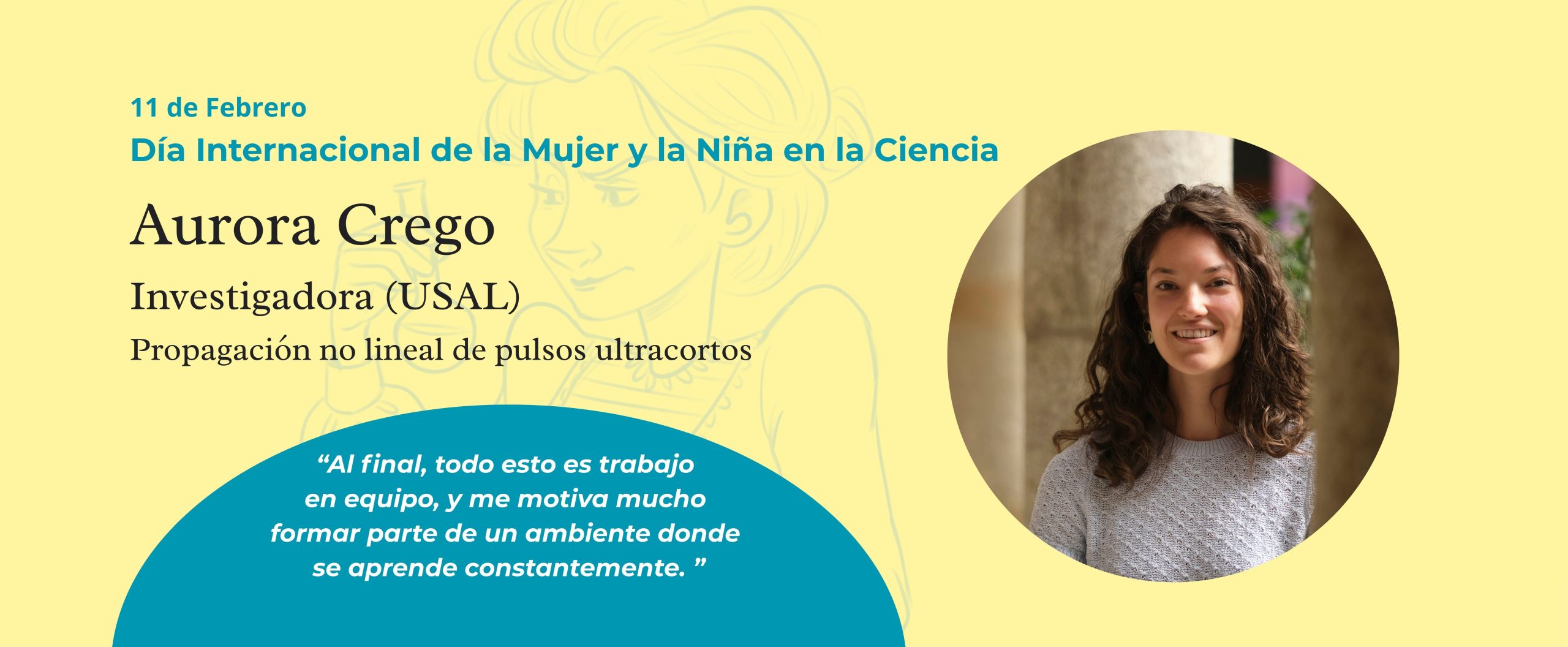
Aurora Crego García is a researcher with the Laser and Photonics Applications (ALF) Research Group at the University of Salamanca. Her research focuses on the nonlinear propagation of ultrashort pulses, both from a theoretical perspective, through the development of computational tools, and experimentally.
This interview was originally conducted by the Women’s Area of SEDOPTICA. The excerpts shown here are published with Auroras’s permission. Click here to see the full interview. This interview was originally conducted in Spanish and translated using an automatic translator. Spanish here
Tell us a little about your current line of research
I am currently part of the Laser and Photonics Applications group at the University of Salamanca, and my main research focus is on the propagation and characterization of ultrashort laser pulses. Specifically, I numerically study the nonlinear propagation of ultrashort pulses and the various nonlinear effects that come into play and play a significant role when they propagate in gas-filled hollow fibers or in free space.
The goal is to understand, control, and optimize these processes, since ultrashort pulses (on the order of tens of femtoseconds) are fundamental for various applications, such as spectroscopy.
This is a topic I began exploring during my doctoral thesis, where I studied effects such as pulse self-focusing, the propagation of beams with various spatial structures (for example, donut-shaped), spectral broadening, and the generation of ultraviolet radiation. Now, during the postdoctoral stage, I have expanded this work by combining the experimental part with the development of numerical models, adapting the code to describe pump-probe configurations, in which two pulses are involved and the nonlinear effects that one induces on the other and their consequence on propagation are analyzed.
What inspired you to choose a career in science or research?
To be honest, I don’t have a specific reason why I chose Physics. I was always torn between several options, but in high school it was one of the subjects that most intrigued me. My teachers encouraged me to apply for a FECYT Summer Science Camp, where we carried out various research activities, one of which included observations at the Cantabria Astronomical Observatory. There I discovered what astrophysicists do to study and decipher the universe, and I think that curiosity to understand how everything works is what leads many of us to study Physics, even though each of us then finds our own path. I understand that they all, in a way, fostered a scientific vocation, and it really worked for me.
What do you enjoy most about your day-to-day life as a scientist?
What I enjoy most about my day-to-day work as a researcher is interpreting results and seeking the “why” from a theoretical perspective, understanding the phenomena I’m studying and making sure everything fits together. I also really enjoy mentoring students, working with colleagues, and learning new things. Right now, for example, I’m exploring topics different from my thesis and I’m thoroughly enjoying this phase. Ultimately, it’s all about teamwork, and I’m very motivated to be part of an environment where we’re constantly learning.
Which part do you find the most difficult or challenging?
What I like least are the administrative tasks and bureaucracy, as well as the uncertainty and instability researchers face and the way research activity is sometimes evaluated. Even so, I try to manage it in a way that affects my work as little as possible and focus on the part I truly enjoy: learning new things.
What obstacles have you faced as a woman in the scientific or academic field?
Personally, I don’t think I’ve faced direct difficulties in the scientific field simply for being a woman, although that doesn’t mean I haven’t been aware of some of them. However, these situations do occur, and I’ve seen how they affect other female colleagues, both professionally and personally.
In recent years, I have noticed some changes. There has been an effort to give more visibility and recognition to women scientists, both those currently active and those who did exceptional work in the past and are only now receiving the recognition they deserve. I myself have even been discovering the work of female researchers I was unaware of until recently, because no one had ever told me about them.
What kind of actions or changes do you think could improve the participation and visibility of women in science?
I think that more and more activities and talks with female speakers are being organized, which helps to make their work more visible, create role models, and ultimately inspire scientific vocations in girls and young women. Even so, I believe there is still much to be done until female representation is naturally equitable, and not something that is deliberately sought after.
Perhaps there are several measures that can help. For example, I think that support networks, like the one you have in the Women, Optics, and Photonics Area of SEDOPTICA, play a key role in making the work of women scientists visible and recognizing them, as well as the situations of discrimination, bias, and work-life balance issues that still exist but of which we are often unaware.
I also think it is crucial to continue promoting scientific vocations and sharing what we do in our work as researchers at all educational levels and with the general public, so that more girls and young women are encouraged and become curious about science.
From within institutions, perhaps spaces and services could be ensured that function properly to support women when difficult situations arise, offering guidance and resources that we sometimes don’t know about.
I really enjoy tutoring students, working with colleagues, and learning new things…
Aurora Greco García