
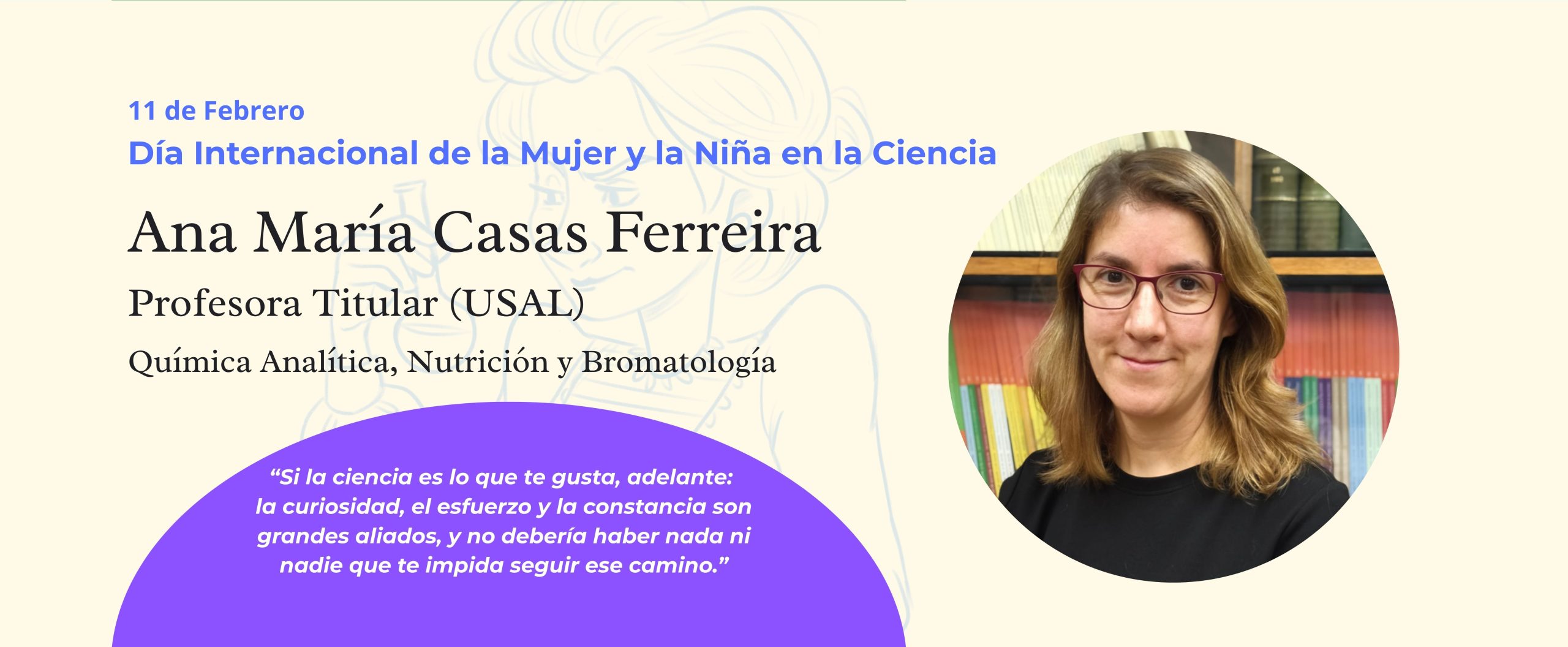
Ana María Casas Ferreira is a tenured professor at the Faculty of Chemical Sciences of the University of Salamanca. She conducts research in the areas of Analytical Chemistry, Nutrition, and Food Science.
This interview was originally conducted in Spanish and translated using an automatic translator. Original here
Tell us a little about your current line of research
My research career has been based in the Department of Analytical Chemistry, Nutrition, and Food Science at the University of Salamanca, where I am a tenured professor. I am part of the Consolidated Research Unit “Mass Spectrometry in Chromatographic and Non-Separative Techniques,” a group specializing in the development of innovative analytical methodologies based on mass spectrometry.
Currently, my research focuses on the development of efficient, rapid, and sensitive analytical methods for the determination of analytes of interest in complex biological matrices. These methods have a clear applied focus and encompass diverse fields: from clinical applications, such as the determination of biomarkers in samples collected using non-invasive procedures like urine, saliva, or breath, to applications in the archaeological field, where we work on the identification and determination of specific peptides that allow for sex assignment in ancient human remains.
What inspired you to choose a career in science or research?
I believe that choosing a research career is a vocation, rooted in human curiosity. Science and research offered me a space where that curiosity was not only welcome but essential: an environment where learning is a continuous process. Furthermore, I am inspired by the possibility of generating knowledge that can contribute, even in a very modest way, to understanding the world and the well-being of society.
What do you enjoy most about your day-to-day life as a scientist?
The opportunity to work in what you are passionate about.
Which part do you find the most difficult or challenging?
More than the scientific work itself, what I find most challenging is everything that surrounds science and is not a direct part of it, such as bureaucracy, which sometimes slows down and hinders the pace of research.
Is there any achievement or project that you are particularly proud of?
One of the projects I’m most proud of is the work I carried out in collaboration with the Department of Prehistory at the University of Salamanca, through Dr. Ángel Esparza. Our collaborators were interested in determining the sex of certain individuals from the Late Prehistoric period, as this would allow them to obtain basic information about social structure and reconstruct the demography and history of ancient populations. Their initial plan was to send the samples abroad for analysis, but due to a series of coincidences, we ended up tackling the challenge ourselves. To do this, it was necessary to analyze certain peptides present in tooth enamel. We began using a previously published method, and although we obtained satisfactory results, we identified significant limitations: the analysis times were very long (more than 100 minutes per sample) and required high-resolution mass spectrometry equipment, which is difficult to access in many laboratories. In our case, we were able to access this instrumentation through the Elemental Analysis, Chromatography, and Mass Spectrometry Service at Nucleus (USAL).
Based on our experience developing rapid methods, we decided to create a new, faster, and more accessible methodology. We developed a method for analyzing these samples, reducing the analysis time to just one minute per tooth and using a triple quadrupole mass spectrometer, a less expensive instrument available in many more research centers. This work not only solved the problem at hand but also opened the door to numerous collaborations with other groups and institutions, such as the Museo Canario, the University of Burgos, the University of Valladolid, and the University of Coimbra, among others.
What obstacles have you faced as a woman in the scientific or academic field?
Personally, I haven’t experienced gender discrimination within the scientific or academic fields. I’ve always felt valued for my merit and ability, which I believe should be the fundamental criteria in any professional environment. Perhaps at times, being young has presented a challenge. Even so, I think intergenerational exchange is invaluable: learning from people with long and established careers provides an essential perspective, while younger people contribute new ideas, approaches, and a great deal of energy.
What kind of actions or changes do you think could improve the participation and visibility of women in science?
I believe it’s important to continue strengthening participation in and the visibility of science in general, bringing it closer to society and fostering scientific vocations from an early age. Showcasing diverse role models and communicating science in an accessible way helps more people identify with this field.
What advice or message would you like to share with girls and young women who dream of pursuing a career in science?
There are many career paths that can be very rewarding, but the most important thing is to choose what truly inspires you. If science is what you love, go for it: curiosity, effort, and perseverance are great allies, and nothing and no one should stop you from pursuing that path.
If you could describe science in one sentence, what would it be?
Science: where mistakes are as valuable as successes.
Ana María Casas Ferreira