
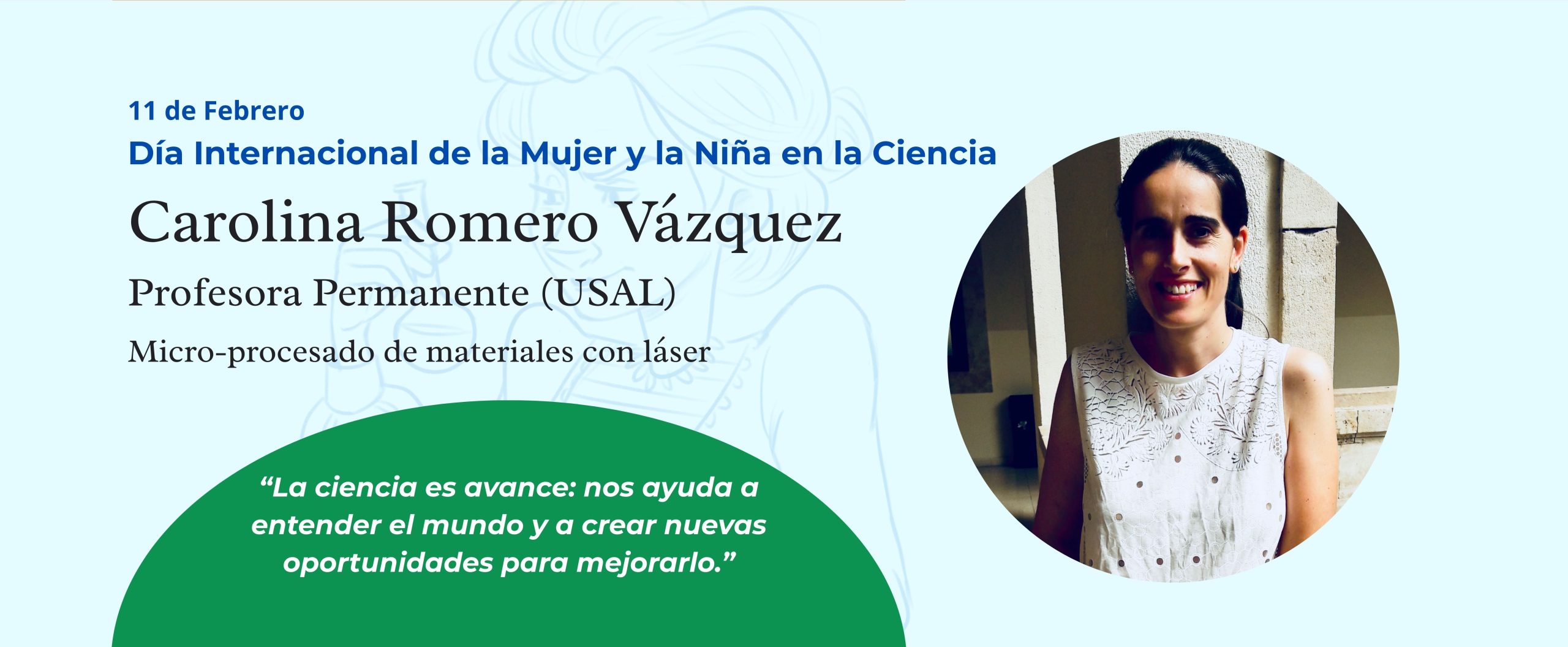
Carolina Romero Vázquez is a tenured professor at the University of Salamanca. She conducts research in the area of Laser Microprocessing of Materials.
This interview was originally conducted in Spanish and translated using an automatic translator. Original here
Tell us a little about your current line of research
What inspired you to choose a career in science or research?
In my case, the path to research arose naturally. During my studies, lasers were an area that particularly sparked my interest, leading me to pursue a master’s degree in lasers. From there, the opportunity to complete my doctoral thesis emerged, and it was during this stage that I discovered I wanted to remain involved in optics research.
What do you enjoy most about your day-to-day life as a scientist?
My day-to-day life as a scientist is quite diverse, and a very important part of my work is dedicated to teaching. Because of this, sometimes a part of me doesn’t feel like a scientist in the strictest sense of the term. However, interestingly, one of the aspects I’ve enjoyed most is precisely the contact with students. I’ve been particularly involved in supervising undergraduate and master’s theses, and guiding students in their first steps in research has been a very rewarding and enriching experience.
Which part do you find the most difficult or challenging?
I think the most difficult part of my job is being able to dedicate time to research, since combining it with teaching is not always easy.
Is there any achievement or project that you are particularly proud of?
I feel very lucky to be able to dedicate myself to something that I am truly passionate about, and I think that in itself is a great achievement.
What obstacles have you faced as a woman in the scientific or academic field?
Not exactly as a woman, but as a mother, I know that balancing parenting with work can be quite a challenge. This experience has taught me to better organize my time and prioritize, but it has also made me more aware of the difficulties in reconciling personal and professional life, both in university teaching and research.
What kind of actions or changes do you think could improve the participation and visibility of women in science?
I believe the focus should be on education. It is essential that boys and girls learn equally from a young age, with the active involvement of parents. If we don’t address stereotypes from childhood, inequalities will always exist that limit women’s participation and visibility in science.
What advice or message would you like to share with girls and young women who dream of pursuing a career in science?
My advice to girls and young women who dream of a career in science is to follow their curiosity and passion. If they like something, they should pursue it and focus their studies on that path.
If you could describe science in one sentence, what would it be?
Science is progress: it helps us understand the world and create new opportunities to improve it
Carolina Romero Vázquez